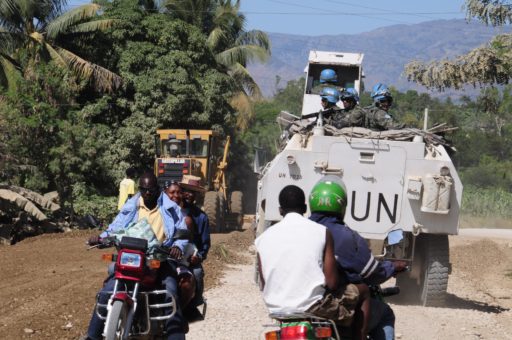
Yet another International Security Mission heads to Haiti with impunity. UK funding for Human Rights Compliance cannot temper the risk.

Facebook
Twitter
WhatsApp

FOR IMMEDIATE RELEASE. The Haiti Support Group (HSG) acknowledges the British government’s recent decision to provide $7.4 million to fund the human rights compliance mechanism for the Gang Suppression Force (GSF) in Haiti. We welcome this UK commitment to human rights and civilian protection, especially given Haiti’s history of serious harm caused by international intervention.

This funding, however, does not address HSG’s widespread concerns about the GSF itself. It has been given a broad mandate and exceptional powers, showing telltale signs of prior missions that deepened violence in Haiti and criminalised Haitian life.

The GSF was authorised by UN Security Council Resolution 2793 in September 2025 to support Haitian authorities to confront the armed gangs that now control much of the country, and to establish conditions for national elections and aid delivery. While officially aiming to provide protection Haitians sorely need, U.S. officials have openly linked the GSF to state securitisation and containment of Haitian migrants headed to the U.S. All signs currently point to the GSF serving as another vehicle to impose imperial control upon Haiti.
A history of impunity in Haiti

The GSF quickly follows the highly controversial Kenyan-led Multinational Security Support (MSS) Mission, expanding on its mandate, its capabilities, and its impunity. This means more security personnel, sweeping powers, and with ‘military-grade capabilities and lethal equipment.’ Chillingly, the UN has granted the GSF the use of ‘all necessary measures’ to achieve its aims and the ability to ‘adopt urgent temporary measures on an exceptional basis’ to maintain safety. The compliance mechanism, partly funded by the UK, exists to prevent, investigate, and publicly report on any violations of international law and human rights.

But such commitment to human rights warrants extreme scrutiny on past international security missions and their violent legacy. Previous interventions have rarely served Haitians, instead prolonging and even worsening insecurity. A recent UN report found that members of the MSS were responsible for cases of sexual violence in the country, and according to  Human Rights Watch (HRW), few internal investigations were ever conducted, and no perpetrators were held to account. International human rights and victims’ groups have recently condemned the complete lack of transparency around the vetting of the roughly 1,100 Sri Lankan army and police personnel set to join the GSF, citing their record of serious violations of international human rights and humanitarian law, including conflict-related sexual violence. These findings are the latest examples of a history of harm wrought by international intervention in Haiti, including the cholera epidemic introduced by UN forces in 2010, which killed more than 10,000 Haitians.

We will continue to monitor these developments with concern and vigilance. We question whether interventions that serve imperial interests can ever be held to account by a compliance mechanism alone. Instead, the HSG calls for transparency and real accountability over recent violence and crimes committed by international forces in Haiti. We call for security solutions to be led by Haitian organisations, Haitian needs, and Haitian voices – not just imposed upon them. And we will continue, as we always have, to support our Haitian partners and amplify their demands for justice, freedom, and self-determination.

In Solidarity,

The Haiti Support Group


Further reading: Haiti Briefing Number 81 (2016) “Unwanted Gifts: A Concise History of Harming Haiti”

Leave a Reply

This site uses Akismet to reduce spam. Learn how your comment data is processed.